

AI Without an Examiner Is not a Title Product. It is a Liability.
How RecordsOnline built the AI workflow that holds up at closing.
Executive Summary
Artificial intelligence is everywhere in title industry marketing today. Most of it stops at chatbots, surface automation, Agents, or re-skinned third-party feeds. The substance of the work — the runsheet, the chain of title, the Schedule B exceptions, the Schedule C cures, the commitment, the policy — sits untouched. All you get is an audit report.
RecordsOnline has taken a different path. After spending years building three foundations that AI in title actually requires: a licensable abstract plant covering 94 Texas counties (approximately 80% of the state’s population), a patented search-monitor-notify platform we own end-to-end, and an experienced Examiner team with an average of 20 years in Texas title work, RecordsOnline was prepared to take on the advantages of AI.
On top of those foundations, a layered/disciplined AI workflow has been built to enable — ChainOfTitleAI, RunsheetAI, and CommitmentAI — examining thousands of documents per file in minutes. An experienced Examiner reviews and approves every chain, runsheet, and commitment before it leaves the platform. AI handles research. The Examiner makes the judgment. The output pushes directly into Qualia, SoftPro, and other title production systems with no rekeying.
This paper explains why that combination matters, why generic AI fails the title workflow, and what customers see when they move runsheet and commitment work onto the RecordsOnline platform.
AI without an Examiner in the loop is not a title product. It is a liability. We built THE loop.
— Celia C. Flowers, Founder, RecordsOnline
1. The Question That Matters
Every title agent has heard the same pitches this year. AI-powered. Revolutionary. Game-changing. The marketing language is identical across vendors. The work product on the desk usually is not.
The Question
How do I use AI in my actual title workflow to deliver a better service to my customers — not in marketing hype, but in what reaches the closing table?
Most AI announcements in this industry do not answer it. They describe a customer-service chatbot. An automation that staples on at the edge of an existing process. A re-skinned third-party data feed. None of that touches the substance of the work.
The substance of the work in title is what matters. A runsheet, a chain of title, a Schedule B exception, a Schedule C cure, a commitment, and ultimately the policy with its jacket are legal-grade deliverables. They cannot tolerate the casual variability that consumer-grade AI introduces.
A chatbot that occasionally confuses Tuesday’s answer with Monday’s is fine. A commitment that occasionally hallucinates a release is not.
RecordsOnline set out to answer the question — not how to talk about AI, but how to deploy it where it produces measurable improvement in the process of title for title agents, underwriters, lenders, and oil and gas operators.
2. The Disciplined AI Workflow
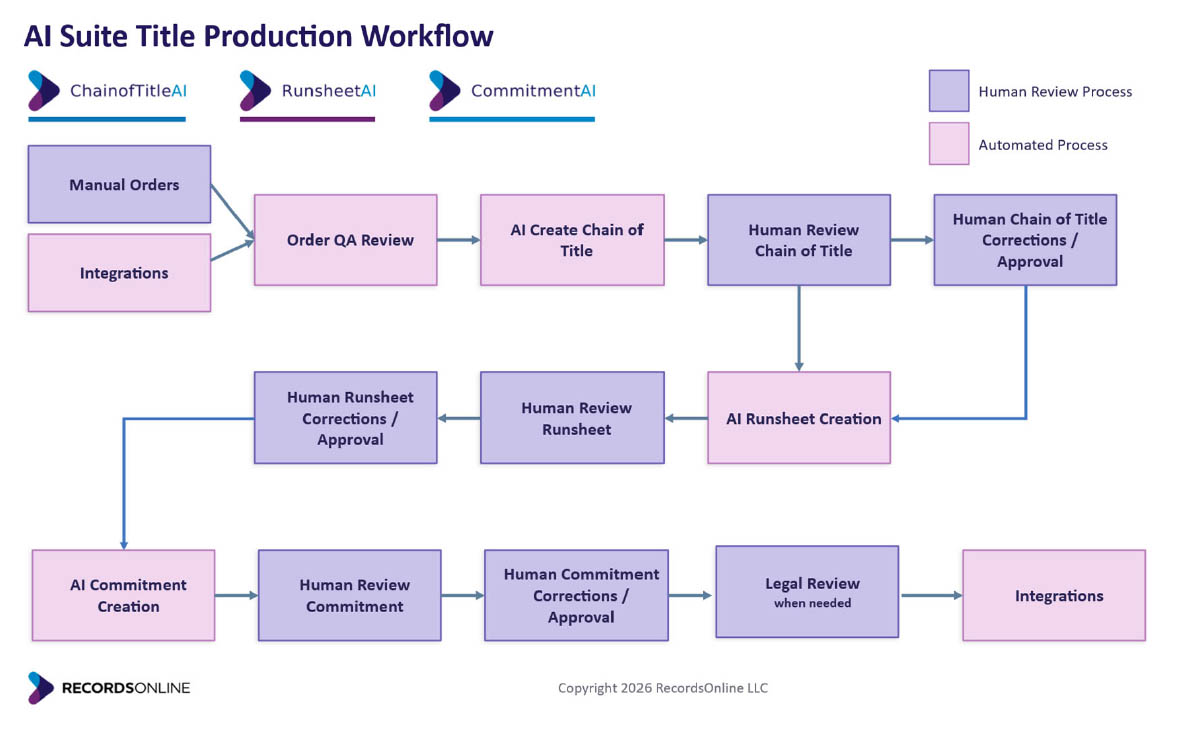
The diagram shows how an order moves through RecordsOnline from intake to delivery. Purple steps are human review and pink steps are automated. Issues flagged by AI loop back to a human for correction before the file moves forward. From order ingestion through commitment delivery, AI handles the volume and the research — and the Examiner, and ultimately the attorney when needed, makes the judgment.
Figure 1. The disciplined AI workflow. Every chain, runsheet, and commitment is reviewed and approved by a licensed Examiner before it leaves the platform.
AI does the research. The Examiner makes the judgment. This is the only configuration that produces legal-grade work product without transferring risk to the title agent or underwriter.
3. Why Generic AI Fails the Title Workflow
Three properties of the title workflow break the assumptions of consumer AI tooling.
Consistency is non-negotiable
Ask a general-purpose large language model for the same question on Monday and again on Tuesday and you may get two different answers. That is acceptable for brainstorming. It is unacceptable for a chain of title that will support a title insurance policy. Title work demands quantifiable, repeatable output — the same instruments, indexed the same way, surfaced with the same exceptions, every time.
The data is unstructured and jurisdictionally weird
County recording practices vary widely. Legal descriptions move between metes and bounds, lot and block, and survey calls. Schedule B items hide inside the body of deeds rather than in indices. Genuine value requires reading into documents, not just scraping their headers. An AI that has never been adapted to county-by-county recording quirks will miss the items that matter.
Liability is real
An unchecked AI hallucination on a runsheet can become an underwriting claim. The industry needs systems where AI does the heavy lifting, but humans approve the result. Anything less creates an unacceptable risk. That is not a reliable posture for an underwriter, an Examiner, or a closing attorney.
The RecordsOnline position
We do not believe in releasing AI in an unchecked manner as a solution to the title industry’s creation of items such as chain of title, runsheets, commitments, and ultimately title insurance policies with jackets. While others have jumped into the water without knowing how deep it is, RecordsOnline has taken the time to analyze the water’s depth, temperature, and clarity. The result is a process where AI exposes exceptions that are hidden and might be missed within a county document. Once exposed, the Examiner can make the decision if the exception is needed on the commitment. This combination of AI and “Human-in-the-Loop (HITL)” creates a work product you can have confidence in.
AI does not stand by itself. For AI to be used in a production workflow, it must be able to be controlled, so future releases do not cause unexpected results tomorrow that were not there yesterday.
— Larry Eppard, Founder Leopard Consulting Group
4. Six Elements of Disciplined AI for Title
The solution combines proprietary plant data, patented platform technology, AI document analysis, and human review into a single workflow. The output is the same deliverables customers have always relied on — runsheets, chains of title, commitments, title evidence — produced faster, with deeper coverage, and with lower variance. Six elements make this approach unique.
1. Direct Access to Texas County Records
RecordsOnline holds licensable plants in 94 Texas counties. Our dedicated plant builders continuously construct and maintain accurate, geography-based plants. This is not a re-skinned third-party feed — it is direct access to the actual property records, scrubbed for accuracy.
2. Patented Platform Built In-House
Our order, search, and notification system is patented software developed by RecordsOnline (U.S. Patent No. 11,023,450 B2). Because we own the codebase, AI integrates natively into search, runsheet generation, commitment preparation, and production-system handoff — not as a bolt-on, but as part of the core.
3. Experienced Examiners in the Loop
The RecordsOnline team averages 20 years of Texas title experience. They review and approve AI output before it reaches the customer. This is the only configuration that produces legal-grade work product without transferring model risk to the title agent.
4. Quantifiable, Repeatable Results
RecordsOnline has engineered our AI process so that results are consistent and auditable. The same property, run twice, produces the same runsheet — the same instruments, the same exceptions, the same flagged items. This solves the single biggest weakness of generic LLM deployments and is essential for title insurance work.
5. Speed and Depth
Manual examination is thorough but slow — a complex file can take days because an Examiner must open and read every relevant instrument by hand. Our AI reads thousands of documents per file in minutes, then surfaces flagged items for the Examiner to review. The Examiner’s thoroughness is preserved. The hours spent are not.
6. Document-Level Relationship Discovery
While leveraging the plant database indices, AI examines directly into the document text to find relationships that are not immediately apparent — cross-references between instruments, parties tied through intermediate conveyances, and the document threads that constitute a defensible chain of title. Schedule B items embedded inside deeds are surfaced earlier in the file, where they belong.
5. How It Works in Practice
From the customer’s perspective, an order behaves the same way it always has — placed through the RecordsOnline platform or through a connected production system such as Qualia or SoftPro. Behind the scenes, the workflow is materially different from a traditional or a generic-AI shop.
Step 1 — Plant-Anchored Search
The order triggers a search across our licensed plants. Because every tract is geographically indexed and historic and current records share the same platform, the search returns a complete set of candidate instruments without database juggling or duplicate work.
Step 2 — Chain of Title AI Document Examination
ChainOfTitleAI “reads” the body of the deed, links together the deeds and audits the results for the Examiner. Deeds not needed are automatically hidden but are still available for the Examiner to review.
Step 3 — Examiner Review and Approval of Chain of Title
An experienced Examiner reviews the AI-flagged items, validates the document chain, and resolves anything that requires human judgment. Annotations are captured directly on the runsheet inside the platform and are visible to downstream Examiners. RunsheetAI then converts the approved chain into a clean, structured runsheet.
Step 4 — Examiner Review and Approval of Runsheet
All necessary documents — deeds, deeds of trust, easements, releases, judgments, probates, plats, are surfaced by AI. Document relationships, Schedule A, B, and C, that a data index alone does not reveal, are retrieved and analyzed by AI. An experienced Examiner reviews the runsheet, validates the Schedule A, B, and C instruments are properly marked, making any adjustments necessary to complete the runsheet. Once all runsheet items are correct the Examiner “approves the runsheet.”
Step 5 —Commitment
CommitmentAI uses a combination of templates, database tables, text files and AI to create the commitment with standard language and all the proper Schedule A, B and C line items. All commitment data is stored in the RecordsOnline database so the Examiner can easily adjust if needed. CommitmentAI will identify and notify the Examiner where it believes issues may exist. The Examiner then reviews and modifies the commitment document, as needed. By the time a commitment leaves, it is complete and with standard language the customer prefers.
Step 6 —System-to-System Delivery
Output is delivered directly into the customer’s production system — Qualia, SoftPro, RamQuest, ResWare, Closingsite, Settlor, ClosingUSA, and others — with no retyping, no re-keying, and no merge-and-clean step on the customer side. From order ingestion to commitment delivery, the integration is end-to-end. Step 7 — Ongoing Patented Notifications After commitment, our patented Search-Monitor-Notify system continues watching the tracked parties and properties. Lots of things can happen between commitment and closing — additional debt, lawsuits, new filings. RecordsOnline notifies customers in real time, so the file is current at the closing table.
6. Customer Outcomes
Customers who move title evidence onto the RecordsOnline platform see results in four categories.
Coverage
Schedule B items embedded in deeds, easements referenced inside other instruments, and cross-document relationships are surfaced earlier in the file. Issues that previously appeared at examination — or worse, after closing — are visible at the runsheet stage.
Speed
AI reads thousands of documents per file in minutes — work that previously consumed days of Examiner time on complex files. Combined with system-to-system delivery, this compresses the order-to-commitment cycle without compressing the review. Residential lot and block commitments are delivered as fast as same day.
Consistency
Because the AI process is engineered for repeatability, the same property produces the same runsheet across Examiners and across days. This is essential for underwriter trust and for any customer running portfolio-scale title work.
Cost Discipline
Direct production-system integration eliminates redundant data entry. Geographic indexing comes at no extra charge. The patented notification system replaces manual bring-forward checks. The economics improve at every step of the workflow.
AI is most valuable when it is disciplined — doing the heavy lifting inside a workflow that an Examiner still owns. The deliverable on the desk is faster, deeper, and more reliable than what came before, because the human judgment that makes it reliable never left.
7. Who This Is For
RecordsOnline’s AI-enabled title services are built for:
▪ Banking and real estate teams — that benefit from tailored title and notification workflows
8. Conclusion
ABOUT RECORDSONLINE AND LEOPARD CONSULTING GROUP
RecordsOnline is a Texas-based title evidence and technology firm with deep operational roots. The platform was launched in 2008 and was rebuilt from the ground up in 2018. As of 2026, East Texas Title dba RecordsOnline is licensed by the Texas Department of Insurance in 94 counties and continuing to expand, with active plans for additional Texas counties and other states.
Founder Celia C. Flowers is one of only a handful of Texas attorneys quadruple-Board Certified by the Texas Board of Legal Specialization — in Oil, Gas and Mineral Law, Real Estate Law, Property Owner Association Law, and Civil Litigation. She has been a keynote speaker and panelist for ALTA, TLTA and other industry organizations on remote closing and title technology since 2018. linkedin.com/in/celia-flowers-69267156
Leopard Consulting Group creates technology solutions built around solving genuine business problems with the appropriate technology. Founder Larry Eppard’s background in building solutions for a variety of clients in the Title Company world, such as RamQuest, Pavaso, RecordsOnline, makes him uniquely qualified to deliver this AI solution. linkedin.com/in/leopard
Affiliated companies — Flowers Davis PLLC, East Texas Title Companies, East Texas Tax & Land Services, and RecordsOnline Title Search and Closing Services (including NotarizeOnline for RON and RIN closings) — give customers access to a full menu of complementary services from a single, integrated source.